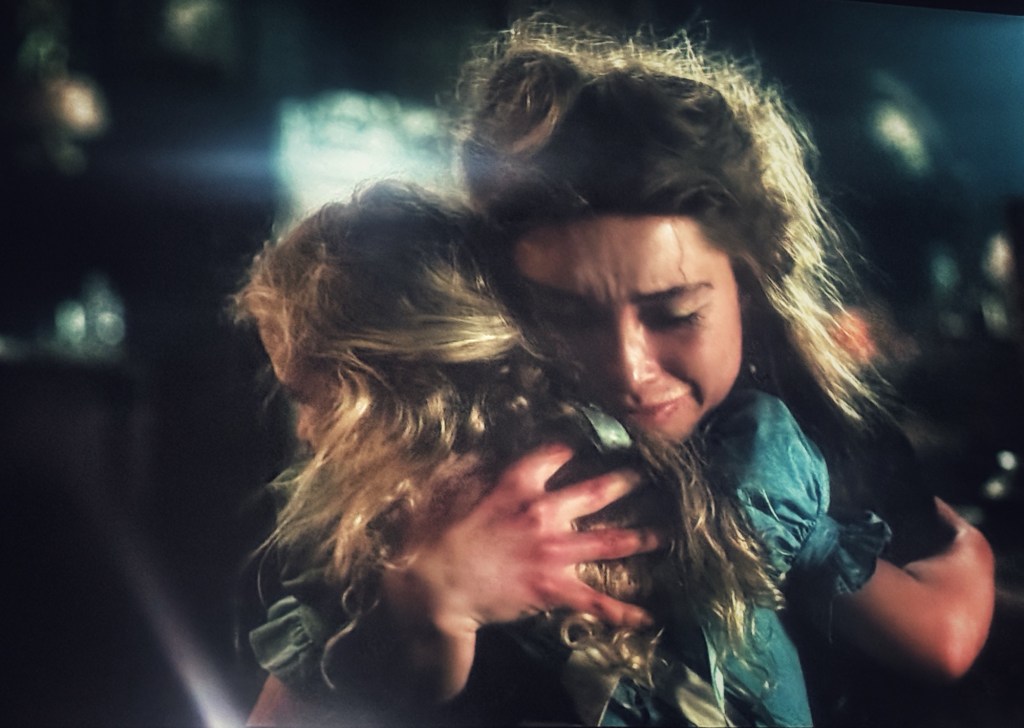
I’ve just finished watching the new adaptation of East of Eden, and it’s sent me down a rabbit hole, quite literally.
We meet Cathy as a five-year-old girl reading Alice in Wonderland. An older boy lures her into a burrow, where we’re left to understand that something terrible happens to her.
Much later, Cathy revisits her Alice reveries, recalling the ‘Drink Me’ bottle that could make her so small that nothing bad could reach her. It’s achingly beautiful and heartbreaking, knowing what happened to her as a child and the life she’s gone on to lead. It’s also her saying goodbye.
The Alice references come straight from Steinbeck’s original novel, where Cathy is portrayed as almost evil incarnate. Steinbeck even considers whether someone might be born with a malformed soul. The adaptation offers another possibility: what happened to Cathy to bring her to where she is?
I’ve seen reviews poo-pooing this attempt to ‘excuse’ Cathy’s monstrous behaviour, but I find myself siding with Zoe Kazan. Not because being hurt gives someone a free pass to hurt others, but because understanding someone’s behaviour is very different from deciding they’re fundamentally rotten.
Why are we so quick to believe in monsters? Why do we so readily accept stories about humans being selfish, cruel and untrustworthy, yet struggle to believe the opposite?
Original sin. Original problem?
I’ve always been bothered by the idea of original sin. That we come into the world somehow wounded, flawed, inclined towards wrongdoing, with natural instincts that aren’t quite to be trusted.
Christian theology is more nuanced than ‘babies are evil’, of course. But the notion that humans need moral guidance and restraint to keep their worst impulses in check has shaped centuries of Western thinking.
And isn’t that a convenient premise if you’re in the business of telling people what to do?
If humans are fundamentally unreliable, somebody has to keep them in line. The Church, the state, the school, the parent. Somebody has to know better, set the rules and save us from ourselves.
Says who exactly?
Religion didn’t invent control, and not all Christian traditions promote obedience over independent moral judgement. Nor am I claiming that every institution built around moral guidance is simply an instrument of domination.
(…or am I?)
But these ideas have seeped into our understanding of being human, religiously, culturally, historically and socially. Once you start looking for the assumption that humans are fundamentally bad, you find it EVERYWHERE.
Especially in the stories we tell.
Lord of the Flies… or Lord of the pretty well behaved buddies?
In William Golding’s Lord of the Flies, schoolboys stranded without adult supervision descend into violence and brutality. Strip away civilisation, and the beast emerges.
It’s an extraordinary novel, and one of our favourite cautionary tales about human nature. Remove authority, remove the rules… and look what happens!
Except…
In 1965, six teenage boys from Tonga ended up stranded on an uninhabited island for FIFTEEN MONTHS.
Six teenage boys. No parents, no teachers, no supervision. Not even anyone to tell them to pick their socks up off the floor.
You can almost hear the ominous soundtrack.
And what did they do? They organised themselves.
They built shelter, collected rainwater, grew food, divided responsibilities and looked after one another. They argued, naturally, but found ways to manage their disagreements.
They even built a badminton court…
When they were rescued, they hadn’t descended into murderous chaos. They’d created a functioning little community.
Rutger Bregman recounts their story in Humankind: A Hopeful History, challenging our assumptions about human selfishness. Sorry Dawkins, not playing for your team.
Six boys on one island don’t establish some universal law of human goodness. They brought their relationships, culture and values with them. But that’s the point. They’re humans too, and their story doesn’t fit our familiar narrative.
Which story became a literary classic, studied by generations of schoolchildren? And which story have most of us never even heard?
Hmmmm…
The problem with a good story
Stories need conflict, drama, tension and danger.
Nobody’s buying a cinema ticket to watch six boys share the washing-up rota for fifteen months. Well, I might. Oooer, the more I think about it, the hotter under the collar I get!
But you see my point.
We LOVE stories about monsters, collapsing civilisations and the terrible true nature of humanity emerging once the rules disappear. It’s great storytelling, but it reinforces a particular view of humanity. We forget the difference between a compelling story and an accurate description of how people behave.
Remember Contagion, the 2011 film with Gwyneth Paltrow, Kate Winslet and Matt Damon?
Watching it after COVID is quite astounding. A virus crosses from animals to humans, spreads rapidly around the world and overwhelms healthcare systems. The similarities are uncanny, although the filmmakers had scientific advisers and drew on genuine pandemic risks.
But the film also portrays society falling apart as the crisis deepens. Looting, violence, panic, people turning on one another. The usual cheerful stuff.
And then COVID actually happened.
We saw selfishness, profiteering, misinformation, inequalities and plenty of people behaving appallingly, but alongside all that, something rather wonderful.
Neighbours shopping for neighbours, communities organising mutual aid, people delivering food and medication to strangers, and enormous personal sacrifices to protect others.
Remember us clapping for the NHS? Not that clapping pays nurses, and that’s a whole other conversation… but there was something genuinely moving about that collective moment.
Research into disasters repeatedly finds that people often respond to crisis with cooperation and mutual support. There’s even a name for it: catastrophe compassion.
How’s that for human-based storytelling?
I find it slightly hilarious that we need a special term for people being nice to one another when things go horribly wrong, as though kindness in a crisis were some astonishing deviation from normal behaviour.
Maybe the surprising thing isn’t that people sometimes behave badly, but how much kindness we fail to notice.
We’re really rather good at noticing the bad stuff
Our brains are particularly responsive to negative information. From an evolutionary perspective, noticing the approaching predator was probably more useful than admiring the flowers.
Now put that brain into a world of rolling news, algorithms, sensational headlines and endless opportunities for outrage. Oh, what fun.
A hundred people doing something kind? Nice.
One person doing something dreadful? STOP THE PRESSES.
Scandal, conflict and fear sell, and we’ve become very good at feeding ourselves a steady diet of the worst things humans do.
Steven Pinker has written extensively about how many measures of human wellbeing have improved over long periods, despite our conviction that everything is getting worse. His conclusions are debated, but the discrepancy between reality and perception is worth considering.
The millions of ordinary acts of kindness that happen every day simply aren’t newsworthy. And I wonder what happens when we spend our lives consuming stories that reinforce the idea that others are fundamentally selfish and dangerous, until we start treating the exception as the rule.
This isn’t just about films and newspapers. It’s about how we understand one another, educate children, design institutions and decide who deserves trust, freedom or control.
The stories we tell about human nature don’t just describe the world. They help create the world we live in.
I’ve often wondered what it would be like if, alongside London’s famous blue plaques, we had pink ones too. Not commemorating famous people or grand historical events, but the little moments of human loveliness that happen around us. The bench where Simon proposed to Sally, the corner where a stranger helped someone in trouble, the house where a friendship began.
Wouldn’t it be lovely to walk through a city dotted with reminders of kindness and connection? Those stories are happening all the time. We just don’t tend to tell them.
And then there are children
Our assumptions about human nature are perhaps nowhere more obvious than in how we treat children.
I’ve always been struck by how much children want to get things right, to connect, belong, contribute and feel capable. Of course they don’t always manage it. Neither do we, incidentally.
But I think we make an enormous mistake when we assume goodness needs to be imposed upon them.
Human babies are ridiculously dependent. We’re hardly the fastest or strongest species, and we don’t even have decent fur. Yet we’ve survived and thrived largely because we’re social creatures. We connect, cooperate and care for one another.
Research with very young children has found spontaneous helping behaviour, sometimes without rewards or instructions. That doesn’t mean babies arrive with a fully formed moral code, or that humans aren’t capable of cruelty. But the foundations for empathy and cooperation appear remarkably early.
So why do we behave as though children need correcting into goodness?
Look at the language we use. A ‘good’ child sits still, listens and does as they’re told. When they don’t, they’re difficult, defiant, disobedient or manipulative.
We readily confuse obedience with morality, when they’re not the same thing. Not remotely.
A child who obeys unquestioningly isn’t necessarily developing good judgement. They’re learning to obey. And a child who questions or refuses isn’t necessarily doing anything morally wrong. They might be developing agency, a sense of self, the capacity to think independently, or the entirely reasonable conviction that the adult in front of them has got it wrong.
Heaven forbid.
Children need guidance, boundaries and support, of course. But what if we started from curiosity rather than correction?
Instead of ‘How do I make this child behave?’, what if we asked ‘What’s happening here? What’s getting in the way? What might help?’
What if the child isn’t being deliberately difficult, but is finding something difficult?
That shift changes an awful lot, and not just for children.
Thou mayest
Back to East of Eden.
Cal believes that because he resembles his mother, Cathy, he’s inherited her wickedness. His brother Aron resembles their good father, while Cal resembles their bad mother. So that’s that. He’s doomed.
But Lee offers him another possibility.
Timshel. ‘Thou mayest.’
Not ‘thou must’ or ‘thou shalt’. Thou mayest.
You have a choice. Your ancestry doesn’t dictate your destiny.
I find that rather beautiful. But I wonder whether Cal’s greatest problem isn’t that he’s inherited evil, but that he believes he has.
What if the story he’s been given about himself prevents him from recognising his own capacity for goodness?
We do that to people all the time, especially children. We tell them they’re naughty, lazy, difficult or disruptive, and then wonder why they struggle to see themselves differently.
We create stories about who people are, and those stories can be terribly difficult to escape.
What if we’ve got it backwards?
There’s a framework at the heart of my work that’s increasingly become a philosophy for how I approach being human.
Understand the range. Understand the conditions. Restore agency.
It comes from working with neurodivergent people, but applies beautifully to humans more generally. I’m interested in what people are capable of, what gets in the way and what might help them reclaim their ability to choose.
One thing working with neurodivergent people has taught me is how much of what we call ‘accommodations’ would make life better for pretty much everyone.
As I often say, we’re not asking for tap-dancing frogs on broccoli moons. We’re generally asking for clarity, consistency, a bit of logic, thoughtful communication, flexibility, genuine connection, authenticity and the freedom to be ourselves without performing some exhausting version of normality.
And isn’t that something everyone would benefit from?
It’s often said of neurodivergent people that they are the canaries in the coal mine. It’s not that we can’t do rules. We can do rules! But it helps enormously when those rules actually make sense.
Many of us respond particularly strongly to perceived injustice, inconsistency or arbitrary authority. That doesn’t mean we’re always right (….or does it?), or that every neurodivergent person experiences this alike. But sometimes we’re less willing, or less able, to quietly accept something that feels fundamentally wrong.
And when you start pulling at that thread, you often discover a genuine problem underneath. Something unfair, illogical, inefficient or harmful that’s been quietly tolerated or papered over because addressing it would be inconvenient.
It’s much easier to call someone difficult than to consider whether they might have a point.
The people who struggle most visibly within a system aren’t necessarily the problem. Sometimes they’re showing us exactly where that system isn’t working, and what they’re asking for might benefit everyone.
How much energy do we spend trying to make people fit the environments we’ve created rather than considering whether the environments themselves could do with a little work?
None of this means being naive about human behaviour. People do terrible things, sometimes deliberately and repeatedly. Accountability matters enormously. But I don’t believe accountability requires an assumption of inherent badness, any more than morality requires obedience.
There’s something rather circular about control. We assume people are untrustworthy, build systems to keep them in line, and when they resist, we take their resistance as proof that they needed controlling.
Round and round we go. Rather a neat arrangement, if you’re the one in charge.
But what if we started somewhere else? What if we assumed that human beings have a genuine capacity for goodness, not an obligation to behave beautifully all the time or a guarantee they’ll never hurt anyone, but something real and worth nurturing?
I wonder what education, parenting, workplaces and even our justice systems might look like if that were our starting point.
Because we’re a peculiar bunch, aren’t we? Messy, contradictory, anxious, funny and occasionally spectacularly annoying. Good grief, have you met us? We make a complete dog’s dinner of things, hurt one another and sometimes behave like absolute idiots. But we also make music, fall in love, help strangers, build badminton courts on deserted islands and stand outside our front doors applauding people we’ve never met.
I don’t know that humans are born good, and I’m not even sure that’s the right question. What I do know is that we’ve been remarkably willing to believe we’re born bad, and that belief has consequences for our relationships, institutions, education and the stories we pass from one generation to the next.
Perhaps we could do with telling some different stories. Not fairy tales where everyone is lovely and nothing bad ever happens, but stories that make more room for the kindness, cooperation and connection that are just as much a part of being human as our capacity to make a mess of things.
Perhaps we could even start putting up a few pink plaques.
After all, it’s much easier to call someone difficult than to consider whether they might have a point. And it’s much easier to call someone evil than to ask what might have happened to them, what brought them to where they are, and whether there’s more to their story than we’re prepared to see.
That doesn’t mean abandoning accountability. It means refusing to let judgement become a substitute for understanding.
And perhaps that’s where we need to start, by questioning the stories we’ve been telling ourselves about what it means to be human.
The strongest change is in the ending, where I’ve let your idea about ‘difficult’ and ‘evil’ do the work rather than surrounding it with additional explanations. It now feels more like an essay unfolding naturally, with the reader trusted to make the connections.

Leave a Reply