Have you ever found yourself apologising for something before anyone has actually accused you of anything?
You ring a company because they’ve made a mistake with your bill and somehow, three minutes in, you’re saying sorry for taking up their time. You ask a question in a meeting and immediately wrap it in layers of padding, disclaimers and a small ceremonial offering of, ‘I might have misunderstood this completely’. Someone is rude to you and, instead of thinking, ‘Well, that was a bit off, what’s their f**king deal?’, your brain launches a full internal inquiry into whether you have accidentally committed a crime against social interaction.
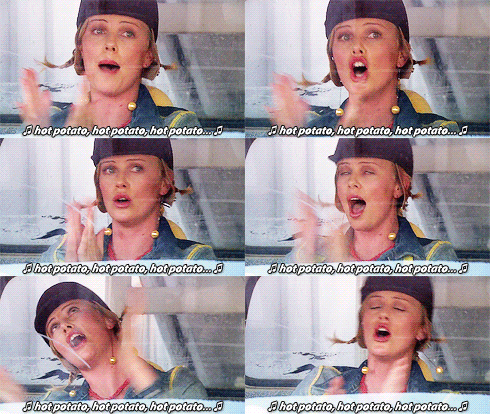
This is what I think of as the hot potato of accountability.
Most people, when something uncomfortable happens, seem remarkably keen to get rid of the potato as quickly as possible. They blame the system, the printer, the weather, the email thread, the traffic, Mercury in retrograde, anything with a pulse or a plug socket. The potato is absolutely not staying with them.
Neurodivergent people, in my experience, often do something quite different.
We catch the potato, inspect it from several angles, wonder if perhaps it was ours all along, and are often surprisingly quick to apologise to it. Some of us may even knit it a tiny emotional cardigan.
And this is where it gets interesting, because I don’t think this comes from weakness, or a lack of social grace, or some tragic inability to stand up for ourselves. If anything, I think it often comes from a place that is genuinely admirable.
A lot of neurodivergent people care deeply about honesty, fairness, authenticity, logic and understanding. We want things to make sense. We want to understand what happened, why it happened and what part we played in it. We don’t want to dodge responsibility. We don’t want to blame other people unfairly. We want the truth, preferably labelled, colour-coded and returned to the correct shelf.
Which is lovely, right up until it isn’t.
Because accountability and culpability are not the same thing.
Accountability asks, ‘What was my part in this?’
Culpability says, ‘This must be my fault.’
And that’s quite a leap, yet leap we do, rather enthusiastically at times.
Part of the reason, I think, is that uncertainty feels unsafe. If someone is abrupt with us, dismissive, unreasonable or unpleasant, one explanation is that they were abrupt, dismissive, unreasonable or unpleasant. The difficulty is that this leaves us with an uncomfortable reality, namely that other people can behave badly and we may not be able to control, explain or fix it.
Our brains don’t always enjoy that conclusion, so they start looking for something tidier.
‘Maybe I asked too many questions. Maybe I was too intense. I surely misunderstood. I should have explained myself better. It must be my ADHD. Maybe it’s just little wrong me all over again.’
And there it is. Horrible, but oddly neat.
Because if ‘it’s me’, at least I know where the problem lives. If it’s me, I can work harder, prepare better, mask more, ask less, need less, be less. Certainty feels safer than ambiguity, even when the certainty is deeply unkind.
This is where we accidentally hand other people a fabulous gift, beautifully wrapped and tied up with a ribbon.
If somebody else has behaved badly and we immediately start explaining why we may have caused it, we’ve given them a way out before they’ve even had to consider their own part in what happened. We’ve offered them the hot potato and then thoughtfully taken it back again before it had a chance to burn their fingers.
How considerate of us. Unfortunately, these good intentions often don’t land the way we hope. Instead, we’re left holding not only the accountability, but also the injustice of not being heard, understood or cared for after making ourselves deeply vulnerable in the first place(see also: fawning).
I don’t think this is exclusively a neurodivergent pattern. Humans do this sort of thing all the time. We naturally assume that other people think in ways that are broadly similar to us because that’s one of the ways we create connection and understanding.
What I do think is different is the intensity. I’ve often described neurodivergence as a brain on amplifier mode. We’re not talking broccoli moons dancing with chocolate bunnies on a treadmill. I’m thinking more along the lines of the canary-in-the-mine version.
The canary isn’t wrong or dramatic, the canary simply notices first.
Where somebody else might have a vague feeling that something isn’t quite right, the canary is already halfway through filing a health and safety report while everyone else is still admiring the wallpaper.
That heightened sensitivity plays a role here, but I don’t think it’s the whole story.
The other piece is trust, or more specifically, the lack of it.
Many neurodivergent people don’t arrive at adulthood with an abundance of self-trust. We arrive carrying years of corrections, criticisms, misunderstandings and negative feedback. Some estimates suggest that children with ADHD hear tens of thousands more negative messages than their peers by the time they reach adolescence. Whether the exact number is 10,000, 20,000 or somewhere in between almost feels beside the point.
The message lands the same: you are getting it wrong, you are too much… or not enough. Too sensitive!
You are the problem.
Not because anybody sat us down and deliberately taught us that lesson, but because when you spend years being corrected, redirected, criticised or misunderstood, that narrative starts to settle into the background noise.
So when something uncomfortable happens, we aren’t starting from a neutral position.
We’re already standing on a slightly tilted, mud-bogged playing field.
Which means that by the time the hot potato lands in the room, we’re often halfway towards claiming ownership before we’ve even checked whose potato it was in the first place.
The answer isn’t to stop taking accountability. Please don’t become one of those people who repels responsibility like a badly waterproofed tent.
Accountability is good!
Reflection is good!
Self-awareness is the key that will unlock your self-esteem and confidence! Seriously!
Being willing to ask, ‘could I have done that differently?’ is a genuinely valuable quality. In fact, this takes me straight to my favourite quote (Charles Bukowski?): ‘The problem with the world is that the intelligent people are full of doubts, while the stupid ones are full of confidence.’
The willingness to question ourselves, examine our behaviour and stay curious about our blind spots is generally a sign of growth, not failure.
The trick is remembering that our part is not the same as the whole thing. Sometimes the potato is yours.
Sometimes it belongs to somebody else. Sometimes it’s a shared potato, which is annoying, but life is full of complex carbohydrates.
Before picking it up and pressing it lovingly to your chest forever, it may be worth pausing for a moment and asking: ‘Hang on. Does this potato actually belong to me?’
And if the answer is only ‘partly’, perhaps we keep our share, because we’re decent humans who care about doing the right thing, and hand the rest back to its rightful owner.
Preferably before it burns our fingers.

Leave a comment